.
Decentralized Autonomous Traffic Management through Corridor Networks
Presented at the Second US-Europe Air Transportation Research and Development Symposium (ATRDS 2026)
Delft, the Netherlands, June 2026
Also presented at the 3rd Annual Northeast Systems and Control Workshop (NESCW)
Princeton University, May 2026
This page covers our full corridor-network study, presented at ATRDS 2026 (preprint on arXiv below). An earlier, more limited version of this work — covering a single corridor, a two-corridor sequence, and a simple split, without running the trained policy on larger multi-corridor networks — appeared at AIAA SciTech 2026; see citation below.
-
Jasmine Jerry Aloor
MIT
-
Aadarsh Govada*
University of Maryland
-
Hamsa Balakrishnan
MIT
MIT
University of Maryland
MIT
*Aadarsh did this work as a collaborator at MIT
Abstract
As autonomous aircraft are introduced at scale and traffic density increases, centralized management becomes insufficient to coordinate the large numbers of crewed and uncrewed aircraft. Dedicated Advanced Air Mobility (AAM) corridors have been proposed for organizing high-density autonomous traffic flows. The desire to scalably provide autonomous aircraft flexibility in trajectory planning motivates the development of decentralized approaches to traffic management in AAM corridors.
In this work, we extend a multi-agent reinforcement learning (MARL) framework for aircraft navigation and self-separation to corridor networks. We test policies trained in a single-corridor setting, without retraining, on increasingly complex multi-corridor networks with combinations of merges and splits. Experimental results demonstrate that learned behaviors transfer well to scenarios with varying traffic density, network geometry, and heterogeneous vehicle performance, without needing centralized coordination or model retraining.
Motivation
- Advanced Air Mobility (AAM) is expected to introduce large numbers of autonomous aircraft in dense urban airspace, creating coordination challenges that centralized ATC cannot scale to address.
- Dedicated AAM corridors organize aircraft into predefined routes, reducing coordination complexity while supporting decentralized decision-making.
- Within corridors, aircraft must maintain separation, conform to corridor boundaries, and minimize congestion-induced delays — all without centralized scheduling.
- MARL enables agents to discover coordination strategies through environmental interaction rather than hand-crafted rules.
Central Question: Can a policy trained in a single corridor coordinate traffic in a complex multi-corridor network without retraining?
Method
Aircraft Coordination as a Dec-POMDP
We formulate the multi-aircraft system as a decentralized partially observable Markov decision process (Dec-POMDP). Each agent observes a local neighborhood and selects actions based on state observations and graph-structured interaction information — no centralized coordinator, no global state.
Corridor Navigation Phases
- Phase 1 (Pre-corridor): Agents approach the corridor, maintain inter-agent spacing, and merge as needed to enter.
- Phase 2 (In-corridor): Agents maintain line formation and longitudinal spacing within the corridor lane.
- Phase 3 (Post-corridor): Agents exit and disperse toward their individual downstream goals.
Key Methodological Advances
- Rotation-invariant policy representation: Observations expressed in the agent's heading frame remove dependence on global orientation, so the same policy works for corridors in any orientation without retraining.
- Curriculum-based training: Reward terms are introduced progressively — early training emphasizes corridor adherence and phase progression; separation penalties are gradually raised as policies mature.
- Transfer without retraining: The trained policy is deployed directly in multi-corridor settings — merging, branching, and combined 18-corridor layouts — with no retraining or centralized scheduling.
Reward Structure
- Separation maintenance: Penalty when inter-agent spacing falls below threshold; stronger penalty when aircraft are also closing in on each other.
- Phase transition reward: Structured bonuses for correct phase transitions; penalties for skipped or reversed transitions.
- Goal completion bonus: Terminal reward upon reaching the goal, only after fully traversing the assigned corridor sequence.
Evaluation Setup
Test Topologies (No Retraining)
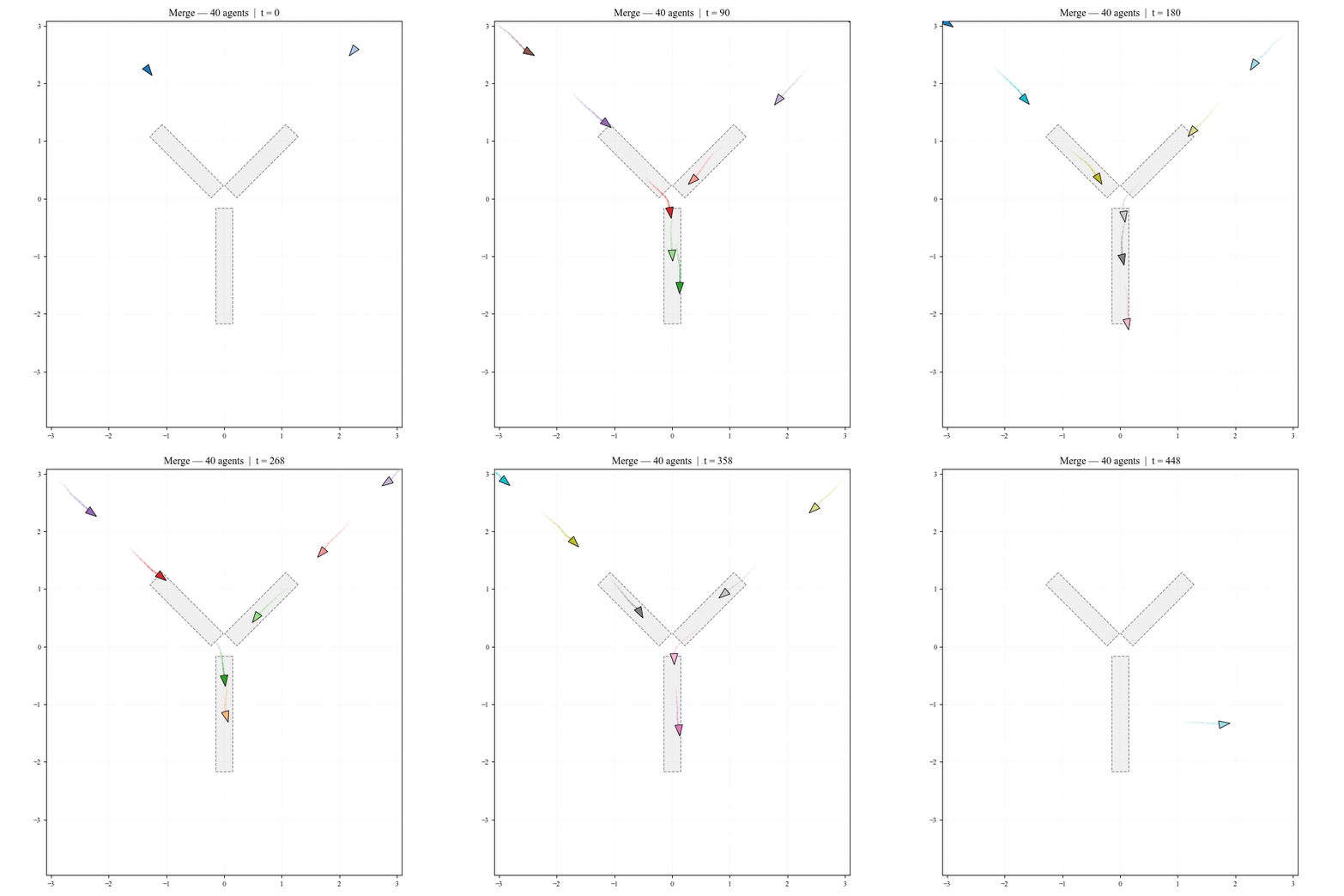
Merge
Two upstream corridors merge into one downstream corridor. 3 corridors total. (40 agents shown)
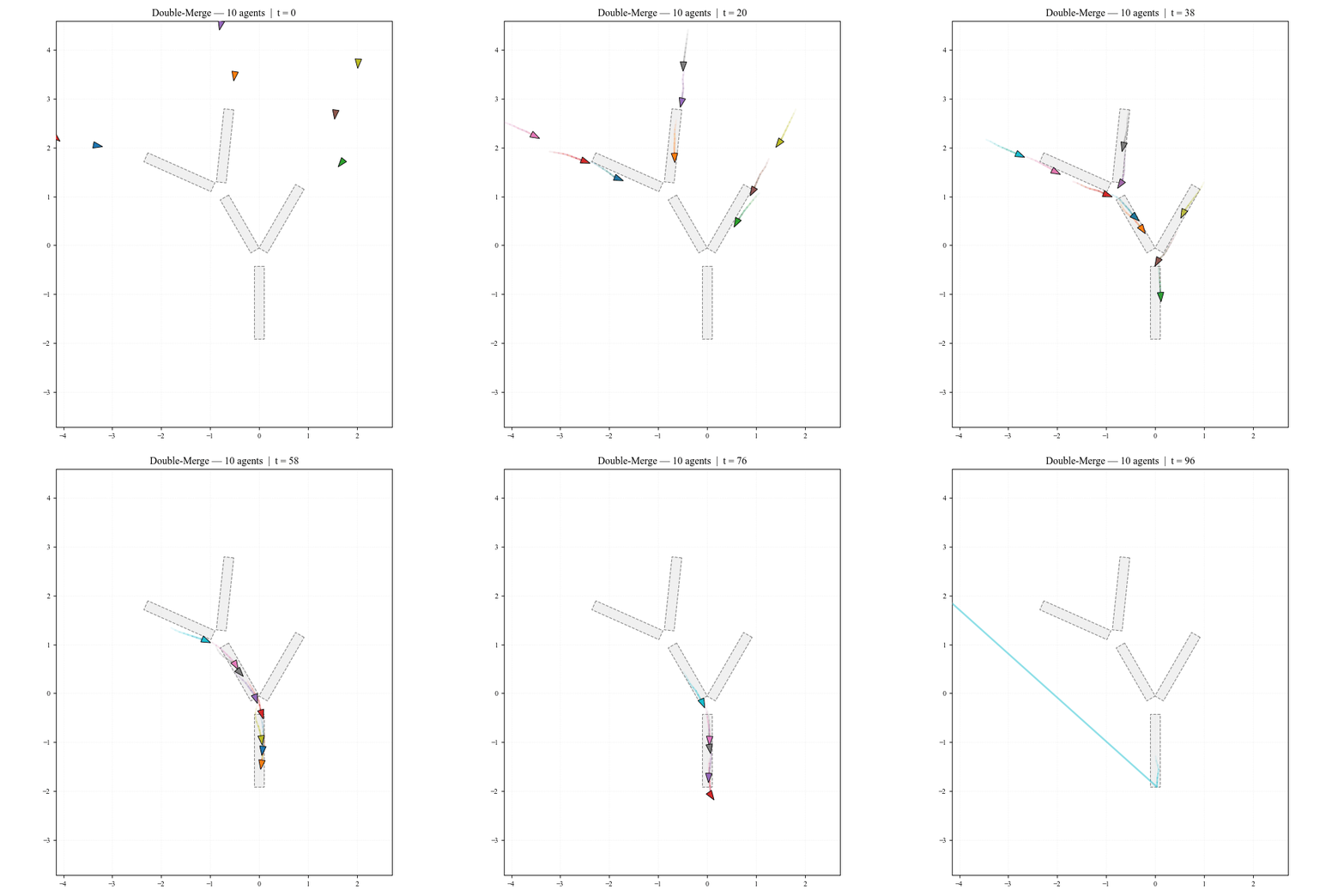
Double Merge
Two sequential merging points with compounded interaction density. 5 corridors total. (10 agents shown)
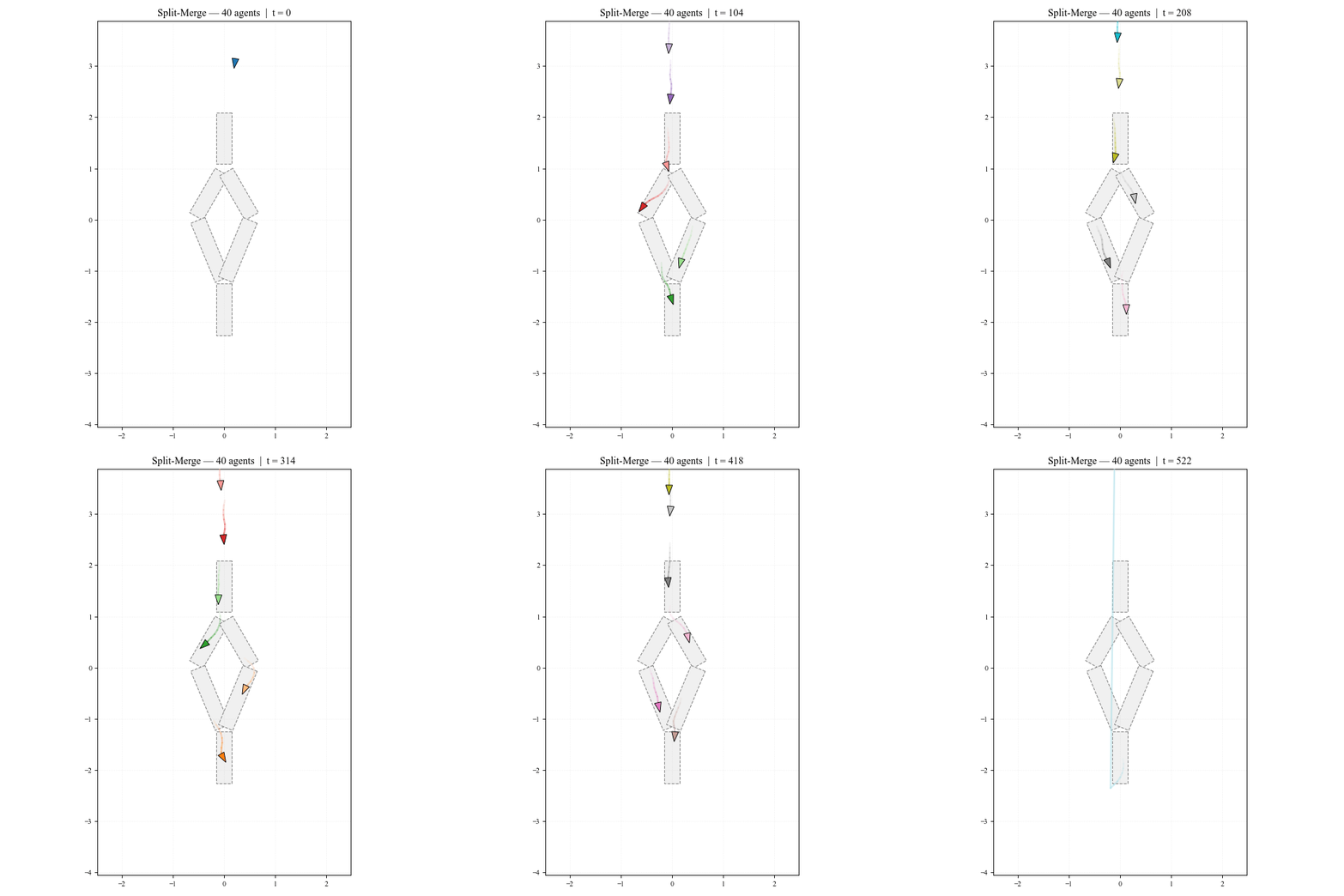
Split-Merge
Aircraft diverge into parallel corridors then reconverge. 6 corridors total. (40 agents shown)
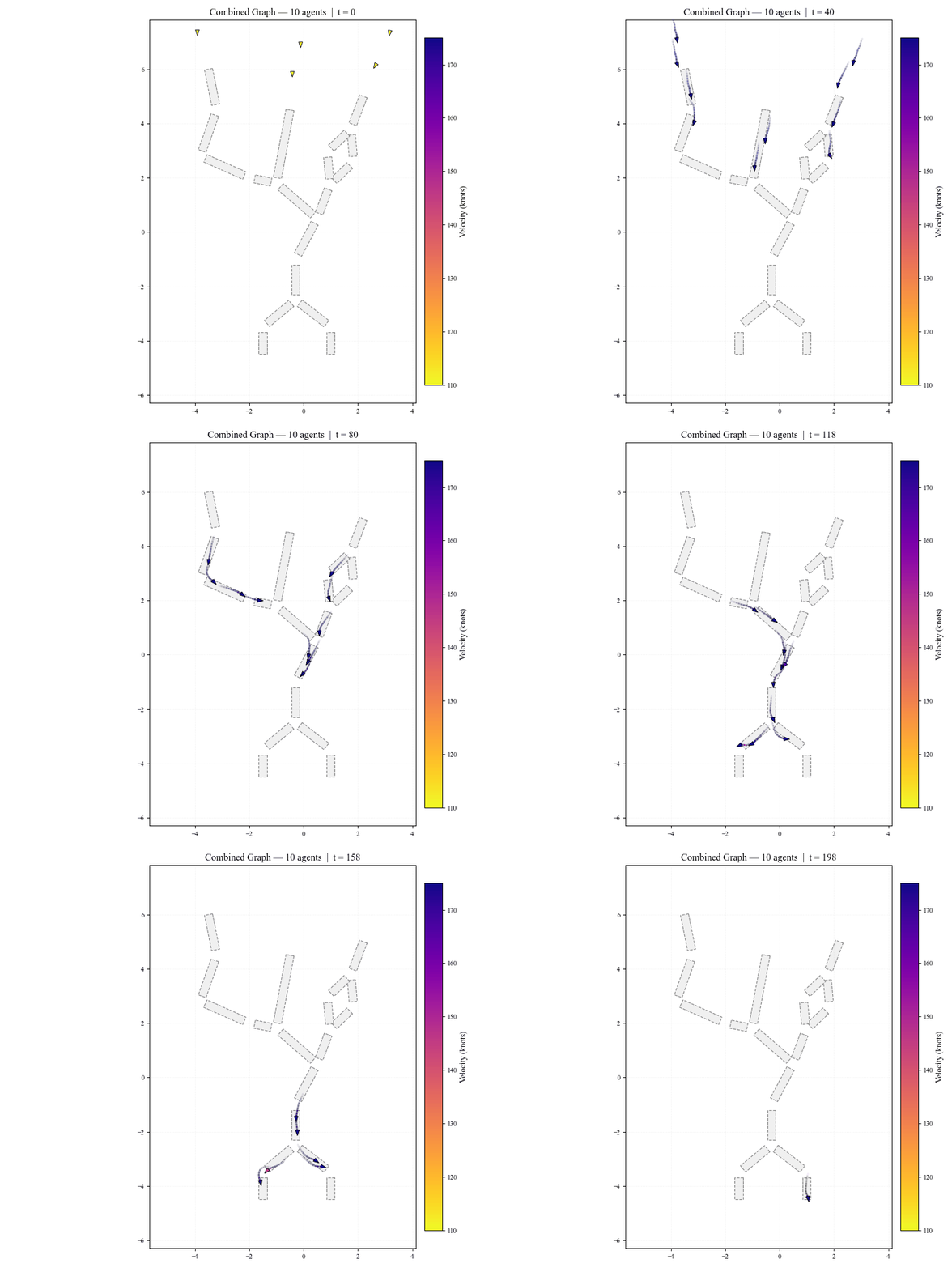
Combined Network
Merges, splits, and sequential chains totaling 18 corridors, 3 entries, 2 exits, 8 routes. (10 agents shown)
Performance Metrics
- Conformance C%: Average percentage of time an aircraft remains within corridor boundaries during the in-corridor phase.
- Completion S%: Percentage of aircraft that successfully navigate their full corridor sequence within the episode.
- Average speed (knots): Total distance traveled divided by time taken.
- Tactical intervention I%: Fraction of time an agent requires tactical deconfliction due to minimum separation violation.
Traffic demand is varied with 10, 20, 30, and 40 simultaneous aircraft. The heterogeneous case assigns 3 agents a reduced maximum speed of 140 knots (20% slower) while remaining agents retain 175 knots.
Results
18-Corridor Combined Network — Homogeneous Fleet
Table 1: Performance metrics for the combined corridor network (18 corridors). The learned decentralized policy maintains strong performance across all traffic levels.
| | # Aircraft | | Conformance C% (↑) | | Completion S% (↑) | | Avg. Speed (kts) (↑) | | Tactical Intervention I% (↓) |
|---|---|---|---|---|
| 10 | 98% | 99% | 171.4 | 3.7% |
| 20 | 98% | 99% | 171.9 | 4.2% |
| 30 | 97% | 98% | 172.8 | 3.6% |
| 40 | 96% | 97% | 173.2 | 3.3% |
Heterogeneous Fleet
Faster aircraft overtake slower ones in the gaps between corridors, even though they were not trained to do so and no reward term encourages it. The presence of slower aircraft does not lead to persistent congestion; aircraft extend their paths outside corridors to avoid boundary violations while overtaking.
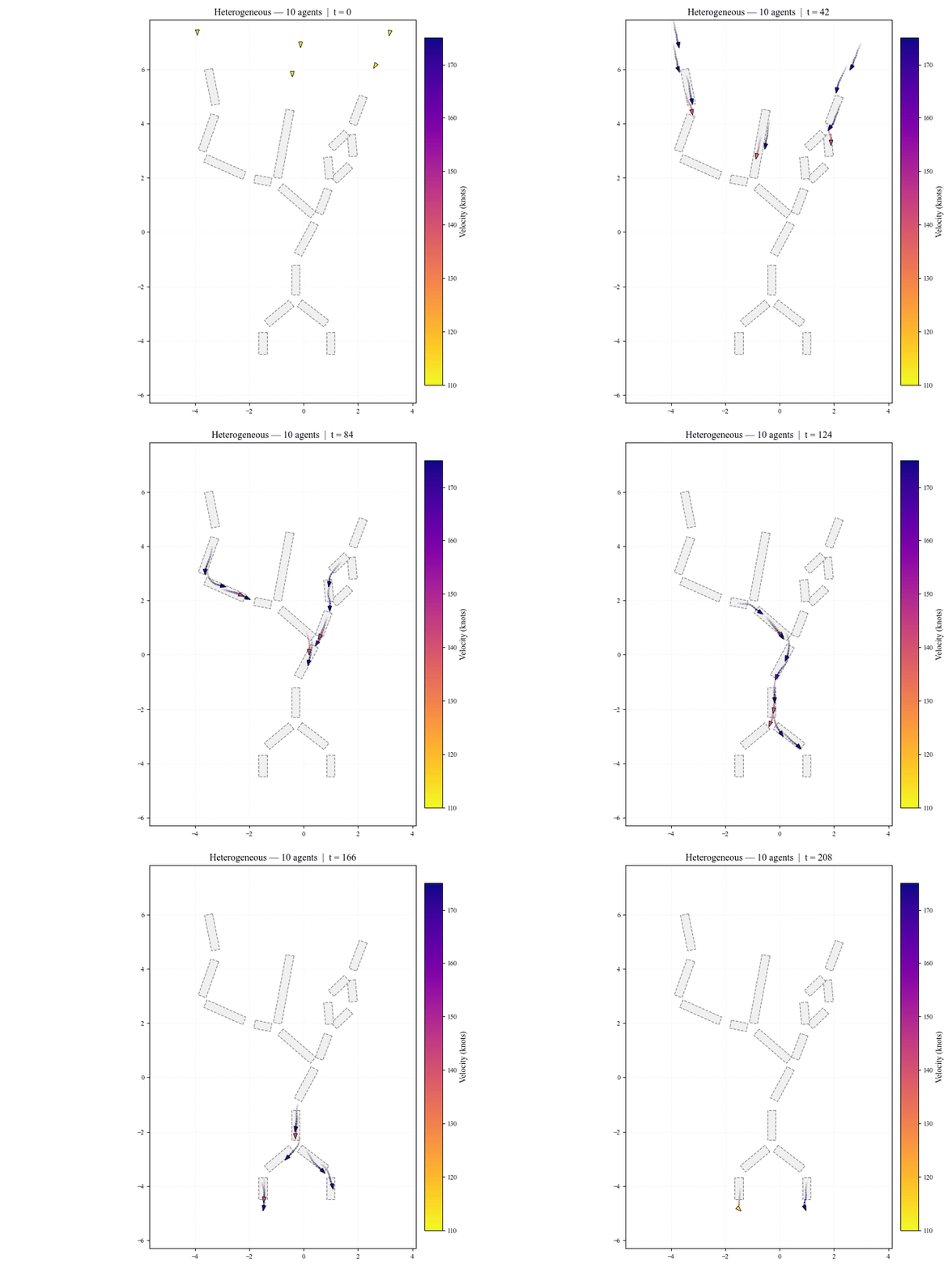
3 of 10 agents capped at 140 knots (20% slower) are overtaken by faster agents in the gaps between corridors.
Efficiency Summary
- Average speed deviates from maximum by only 5.4% in the 40-agent scenario.
- Actual distance traveled is within 8% of the shortest possible routes.
- Peak throughput reaches 14 aircraft/min, within about 1 aircraft/min of the upper bound of 15 aircraft/min.
- Tactical intervention needed less than 5% of the time, even in congested 18-corridor scenarios with multiple merges.
Key Takeaway: A decentralized MARL policy trained in a single corridor with 5 aircraft achieves ≥96% corridor conformance and ≥97% completion in an 18-corridor network with up to 40 aircraft, without retraining or centralized coordination.
NESCW 2026 Poster
Presented at the 3rd Annual Northeast Systems and Control Workshop, Princeton University, May 2026.

Scan to visit this project page
jaroan.github.io/jasminejerrya/AAM_Corridor_MARL.html
Conclusions
- A rotation-invariant MARL policy trained in a single corridor with 5 aircraft runs without retraining on 18-corridor networks with up to 40 aircraft.
- Corridor conformance (≥96%) and completion rates (≥97%) remain strong even at the highest traffic densities tested.
- Tactical interventions are needed less than 5% of the time, demonstrating that learned strategic behaviors handle the majority of coordination.
- Peak throughput is within about 1 aircraft per minute of the upper bound.
- In mixed-speed fleets, faster aircraft overtake slower ones in the gaps between corridors without being trained to.
- Structured airspace design and decentralized policy learning are complementary approaches to scalable AAM traffic management.
Related Links
Other related papers from the DINAMO Lab
- Layered Safe MARL: Resolving Conflicting Constraints in Multi-Agent Reinforcement Learning with Layered Safety. RSS 2025.
- Fair MARL: Cooperation and Fairness in Multi-Agent Reinforcement Learning. ACM Journal on Autonomous Transportation Systems, 2024.
- Time-To-Reach Separation and Safety Filtering for Safe, Fair, and Efficient Multi-Agent Coordination. IEEE CDC 2026, invited session (to appear).
- InforMARL: Scalable Multi-Agent Reinforcement Learning through Intelligent Information Aggregation.
Contact
For any questions, please contact Jasmine.
Citation
If you find our work useful in your research, please consider citing the ATRD Symposium paper (full multi-corridor network study, preprint on arXiv):
The earlier, more limited version of this work (single corridor, two-corridor sequence, and a simple split) appeared at AIAA SciTech 2026:
Acknowledgments
The authors thank the MIT SuperCloud and Lincoln Laboratory Supercomputing Center for high-performance computing resources. This work was supported in part by NASA under grant #80NSSC23M0220 and the University Leadership Initiative (grants #80NSSC21M0071 and #80NSSC20M0163). J.J. Aloor was also supported in part by a MathWorks Fellowship. This research was also sponsored by the Department of the Air Force Artificial Intelligence Accelerator and was accomplished under Cooperative Agreement Number FA8750-19-2-1000. The views and conclusions contained in this document are those of the authors and should not be interpreted as representing the official policies, either expressed or implied, of the Department of the Air Force or the U.S. Government. The U.S. Government is authorized to reproduce and distribute reprints for Government purposes notwithstanding any copyright notation herein.